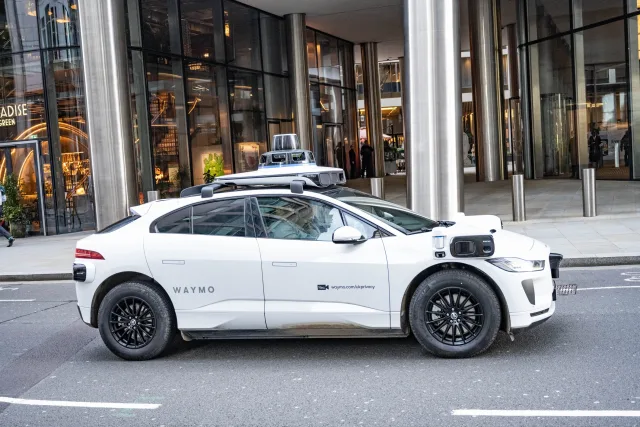
Trials underway in London are paving the way for robotaxis in every town and city across the UK.
There is still a long way to go before conclusions can be reached about the trials and the necessary legislation is in place to allow autonomous cabs to operate on your doorstep.
But for those driving in London now — as well as those encountering them in future — Patons Insurance has worked with industry experts explain what happens if you are involved in a collision with a robotaxi.
Legal framework
The Automated Vehicles (AV) Act 2024 established the legal framework for self-driving vehicles to operate on the UK’s roads. Many of the details of operational requirements are still being worked out in legislation.
The act sets out the ground rules relating to responsibility. When a vehicle is operating in authorised self-driving mode, responsibility does not rest with a human driver, if one is present, but with regulated entities, including the Authorised Self-Driving Entity (ASDE) and, where there is no driver in the vehicle, a licensed No-User-in-Charge (NUiC) operator.
The Government is currently consulting on key elements of the regime, which are expected to set out requirements for incident detection, collision response, data retention, reporting and operator oversight.
While the detailed rules have not yet been published, the intention of the legislation is that victims of road traffic collisions involving autonomous vehicles should continue to have a clear route to compensation, with legal accountability transferring from the human driver to the organisations responsible for the vehicle’s self-driving operation.
Claims process
Many of the steps you take if you are involved in a crash with a vehicle now will also apply to driverless taxis.
Safely bring your vehicle to a stop, note the AV’s registration number, vehicle make and model.
If possible, take photos and/or a video of the incident scene and any damage. If any witnesses are at the scene, you should attempt to obtain their contact details.
Consider contacting the emergency services if anyone is injured or the incident is blocking a road.
Report the incident to your own insurer and pass them the details of the AV that was involved in the incident. They will be able to use these to locate the insurer of the AV.
If you were not using a vehicle at the time, reporting the incident to the police will provide you with a route to establishing the identity of the insurer.
If the autonomous vehicle doesn’t stop
If the AV does not stop at the scene, it is important that you attempt to note as much as you can about the appearance of the vehicle, and the registration number.
You should also specifically note the location of the incident and the direction in which the AV was travelling because this may be of use in confirming the presence of the AV through its telematics data.
Exchanging details
The specifics of how parties exchange details are still being worked out by the Government. Industry experts expect driverless vehicles will have to externally display contact details of their owner or operator, which can be noted down by third parties involved in a crash.
The AVs are likely to have camera equipment on board which will record details of any incident. This information would be retained by the owner/operator and will be of use in confirming the details of the incident.
Liability
Determining liability for an incident will be done much as it is now, using the available evidence to determine the facts of each case.
In some ways, it may be easier to attribute liability correctly due to the increased likelihood of there being high-quality footage of the incident taking place.
The details of insurance liability are still being worked out, but in the first instance, if the driverless car is deemed responsible, the insurer of that vehicle would generally be expected to compensate injured third parties and other innocent victims.
Depending on the framing of the law and the circumstances of the case, they could then pursue claims against one or more potentially responsible parties, including the vehicle operator, manufacturer or software developer.
This could happen if the loss arose from the behaviour of the authorised automated driving system, the vehicle manufacturer, where there is a product defect or manufacturing fault, or the software developer or system supplier, where a defect in the automated driving software contributed to the collision.
Maintenance providers could also be found liable if inadequate servicing, calibration or repair played a role in a crash.
A human user or owner could be deemed responsible if the collision arose from misuse, unauthorised modifications, failure to maintain the vehicle, or conduct falling outside the scope of authorised self-driving.
How are passengers affected?
The rights of passengers to claim following an accident remain unchanged, but the details are still being determined.
Following a crash, they can call the police and engage the services of a law firm to represent them in a claim.
They should retain details of the journey, how it was booked (such as an app) the incident location and a description of events.