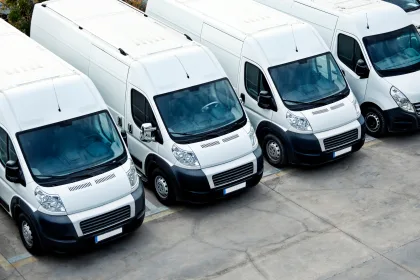

Technology can gather and assess data covering every aspect of fleet vehicle use.
Most fleet operators use software and telematics to reduce their admin burden. But many have yet to discover the possibilities AI can offer, including improvements, efficiencies and, ultimately, savings.
The question for fleet owners and managers now is how can I use it to benefit my business?
Driving change
As artificial intelligence continues to develop, individuals and businesses are finding more ways it can not only save time and boost productivity, but can also be used to solve problems.
Insurance Edge reports that the use of AI is expected to “increase significantly” in the near future to assist with fleet maintenance, consumables and optimisation.
Noting the latest findings from Targa Telematics, it said: “The use of artificial intelligence is set to increase significantly among fleet managers and mobility operators for the development of digital solutions and platforms for connected mobility.”
Targa, working with the Connected Vehicle & Mobility Observatory of Politecnico di Milano School of Management, studied the Italian market and found that 73% of fleet managers are considering and currently assessing the implementation of AI-based solutions within their fleet management operations, while only 23% ruled out this possibility in the near future.
Prevention better than cure
It found: “Predictive maintenance (38%), anomaly detection (24%), predictive analytics dashboards (19%) and consumption analysis and optimisation (14%) emerged as the most important areas for AI integration.
“The Politecnico di Milano research also examined vehicle users’ perceptions of the benefits of telematics, with 46% of respondents highlighting ease of use and 23% focusing on features such as operational support and assistance.”
The research is based on analysis drawn from fleet and mobility managers operating a total of nearly 60,000 vehicles across different types of fleets, including corporate, operational, commercial and field service fleets.
One of the key areas for fleet operators is prevention, which makes them able to address small issues before they become major problems.
Evolving and transforming
Michele Cipullo, Go To Market Manager at Targa Telematics, said: “Artificial Intelligence represents the main driver of evolution in fleet management, as it unlocks a truly proactive approach centred on early identification of potential issues and enhanced support to decision-making.
“Data from the Top Thousand and Top Hundred observatories confirms that the market is ready to fully embrace AI. We are no longer at the experimentation stage, but rather rapidly advancing along the adoption journey.
“Artificial Intelligence is the next frontier in fleet management across every market, and the UK is no exception.”
Chris Horbowyj, UK Commercial Director at Targa Telematics, added: “From enhancing fuel efficiency, a crucial priority at a time of economic uncertainty, and optimising routes to improving driving behaviour and reducing incidents, AI is having a transformative impact on the sector.
“Vehicle misuse prevention is yet another area where AI has already left its mark. Recent research from Targa Telematics Observatory showed that recovery rates may exceed 90% for operators capable of harnessing Agentic AI.
“Indeed, AI has redefined our ability to leverage data and turn it into actionable insights that take performance, safety and sustainability standards to new heights.”
For fleet managers, the question is not whether AI can help their business, it is how. Incorporating the technology should be seen as a strategic move and be included in business plans, rather than being something that is only being used in part of a company.
While AI might be introduced to help with a specific issue, it can be introduced into other areas which help deliver holistic approaches which generates greater improvements and efficiencies.