
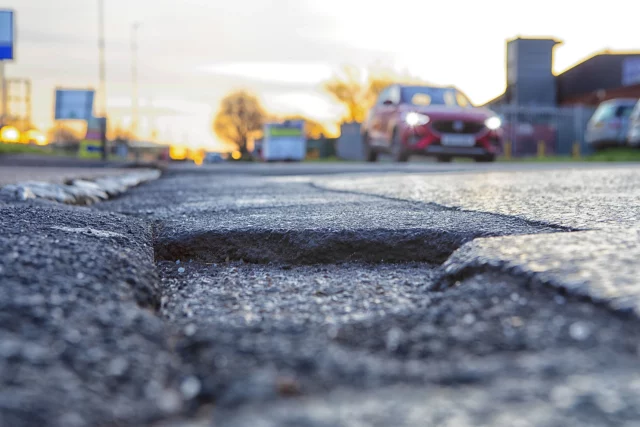
Potholes can cause thousands of pounds worth of damage to vehicles, from tyres and wheels to broken steering and suspension.
As well as the cost of repairs — whether drivers claim on their taxi insurance, other professional driver policy or make a claim against the council responsible for the road — they also face the inconvenience of their vehicle being off the road, causing headaches for fleet managers, as well as the self-employed who rely on their vehicle to earn a living.
Pothole plague
Potholes occur when water enters cracks in the road surface and expands when it freezes. Recent storms and heavy rain have made the problem worse, with the RAC calculating that there are more than one million potholes on our roads today.
According to experts, what the Department for Transport calls the “pothole plague” isn’t going away, with the Asphalt Industry Alliance (AIA) telling the BBC that the cost of bringing all local roads in England and Wales up to standard would be an estimated £18.6 billion — and would take 12 years to complete if the money was available now.
The government has announced total of £24 billion for local road maintenance over the next five years, with £1.6 billion being used to tackle potholes this year.
But the problem goes much deeper than that and experts warn that no one has a bird’s-eye view of the true state of the country’s road network.
Steve Birdsall, CEO of digital roads and data mapping company Gaist, told Fleet Point that we need to see the bigger picture, rather than simply filling holes when they appear.
Bigger picture
He said a more “data-driven approach” is needed to understand the true scale of the pothole problem, which will drive a “realistic approach to road maintenance”.
“Without a full digital condition assessment of all of the nation’s roads, it’s impossible for authorities to understand the extent of the problem. They can’t track progress over time, and they’re unable to confidently calculate the funds needed to get the UK into a position where preventative treatment is the lead approach of managing a road, rather than the reactive repairs that dominate now.”
Mr Birdsall believes that the pothole problem goes far beyond maintenance and should be looked at from a decision-making level.
He said: “Measuring potholes is a distraction. Potholes are the visible symptom of roads that have already deteriorated. Once a surface starts to fail, damage accelerates quickly, and short-term patching becomes a costly cycle that delivers diminishing returns.
“A number of local authorities are now being rated ‘red’ for road condition, but councils do not have a full picture of their roads to be able to prioritise spending efficiently and for maximum impact.
Roads health check
“Instead, they must repeatedly dispatch crews to patch individual failures, which comes at the expense of preventative work that would extend the life of entire road sections. Many are trying to do the right thing with limited resources, but without a clear, consistent picture of asset condition, road maintenance is effectively guesswork.”
He believes the UK needs a “comprehensive annual health check of the entire national network to measure the pace of deterioration or distinguish between weather-related damage and structural decline”.
By identifying early defects, authorities can step in before a failure occurs.
Highlighting the scale of the problem, the AIA reports that roads are only being resurfaced, on average, “once every 97 years, and that almost one in six local roads – equivalent to over 32,500 miles – had less than five years’ structural life remaining”.
The DfT says 15% more pothole-prevention works carried out were carried out last year compared to 2024, but experts still believe an overall picture is needed to tackle the problem and improve the quality of roads across the UK.