It could be one small step for man, one giant leap for flying taxis.
As tech companies around the world battle to launch the first flying taxi, promised launch dates have been put back for a variety of reasons – safety being one of the biggest.
Ahead of the 2024 Olympic Games in Paris, German aviation start-up Volocopter hoped its autonomous VoloCity aircraft would be whisking athletes and spectators across the city. But it was grounded by delays obtaining necessary safety licences.
Archer Aviation hopes to pick up the baton for the Los Angeles games in 2028 but, like Volocopter, it is not yet certified by the US Federal Aviation Administration to be ready for commercial use.
Another American rival, Wisk, has set its sights set on the 2032 Games in Australia.
Rocket science
As these and other companies go for gold, the relative infancy of the industry means many are struggling to overcome technical issues, scale production, or prove their aircraft can meet the same safety standards as airliners.
Now they could be given a boost by an agency that is more accustomed to reaching even greater heights.
The Institute of Mechanical Engineers reports that NASA is testing an eVTOL (electric vertical take-off and landing) aircraft, the results of which could help different manufacturers lift off.
While technical details of each of the commercial prototypes being developed by tech companies are being kept secret, the institute says NASA’s research at the Langley Research Center in Hampton, Virginia, could be a gamechanger for the industry, by producing produce public, non-proprietary data available to all.
The tests are giving NASA engineers real-world data on air taxi designs, “improving understanding of flight dynamics and helping them design better flight control systems. These systems help stabilise and guide the motion of an aircraft while in flight, making sure it flies safely in varied conditions.”
Research
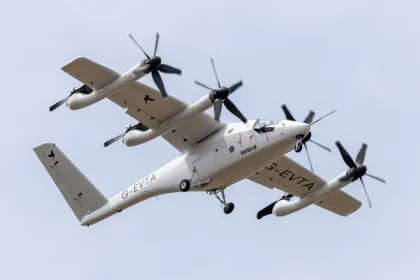
NASA’s test aircraft resembles a scaled-down air taxi that aircraft manufacturers could use for their own designs.
Siena Whiteside, who leads the Research Aircraft for eVTOL Enabling techNologies (Raven) project, told the institute: “NASA’s ability to perform high-risk flight research for increasingly automated and autonomous aircraft is really important.
“As we investigate these types of vehicles, we need to be able push the aircraft to its limits and understand what happens when an unforeseen event occurs.
“NASA is willing to take that risk and publish the data so that everyone can benefit from it.”
NASA is testing the aircraft for a variety of scenarios, including motor failure, strong winds and bad weather.
In a further step to helping flying taxis become a reality, NASA developed its custom flight controls using tools from Massachusetts software company MathWorks, allowing the researchers to reduce development timescales.
Researchers hope that the 17kg test aircraft, with a wingspan of 1.83 metres, will be a stepping stone to support development of a much larger 454kg aircraft, which would resemble a real flying taxi.
The institute reports that this aircraft is being designed in collaboration with the Georgia Institute of Technology and would also serve as an acoustical research tool, helping engineers understand the noise flying taxis might create.
Although billions has been spent globally by those trying to get the first flying taxis off the ground, most are limited in their experience of aviation. The input and experience of NASA to create minimum standards for the technology to speed up the process could pave the way for flying taxis sooner than we think.