As the cost of living continues to take its toll, people are finding new ways to try to make ends meet, including cheaper car parts to drive down the cost of repairs and maintenance.
But experts are warning that saving a few pounds here and there could not only be more expensive in the long run, it could also cost lives.
Cutting costs
A mechanic told the BBC that customers regularly ask him to fit cheaper – and often fake – parts they have bought online in a bid to reduce their bill.
But Paul Jones, owner of PC Automotive in Lincoln, says many of the “bargain” parts are either faulty or not safety tested.
He said: “The thing that made me wince was fake airbags. You can imagine an explosive device five inches from your face. If that goes off, it doesn’t bear thinking about.
“You’re doing 70mph at certain points with a faulty component on it, it’s only going to go one way. They are taking their lives in their hands. It’s what’s keeping you alive when you’re on the motorway.
“It’s not about garages making money. We don’t want someone behind us when we’ve got the kids in the back seat, whose got a faulty car or one that’s been bodged up.”
Mr Jones, who has been a mechanic for 35 years, said will only fit genuine parts that come with the usual guarantees.
Campaign
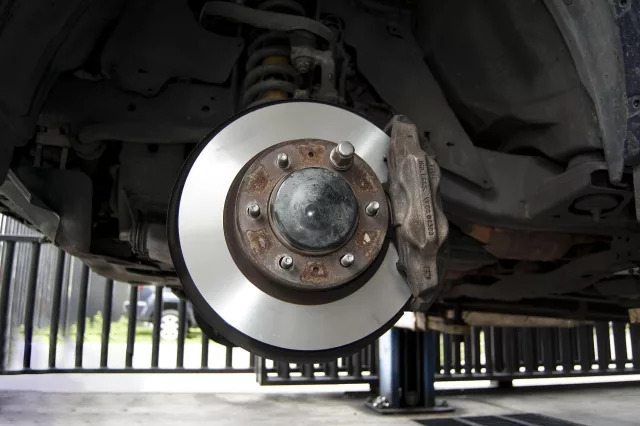
In a bid to highlight the dangers of fake and faulty vehicle parts, the Intellectual Property Office launched the Fake Always Breaks campaign, which warns that the most common fakes included airbags, brake pads, wheels and car batteries.
The IPO told the BBC it found one in six motorists admitted to buying a counterfeit part in the previous 12 months.
Miles Rees, IPO deputy director of enforcement, told the BBC: “If you see something at a significantly cheaper price, that’s a reason to be wary.
“It’s the old adage; if it seems too good to be true, it probably is.
“Illicit goods are not subject to safety tests and are likely to be made using vastly inferior materials.
“This puts them at increased risk of failure, with potentially devastating results.”
And he warned that counterfeit goods are often linked to organised crime and wider criminal activity.
Cashing in
As well as unreliable parts being pushed on to mechanics, manufacturers are also losing out to people who counterfeit their products and parts.
Some companies have seen their products appear as counterfeits and sold online – with gangs using a reputable name to make money selling fake parts.
Lincolnshire-based Drury Precision Engineering, which manufacturers motorcycle parts and accessories, revealed that within six months of a new product being launched, fake versions are being sold on the internet.
Director Dan Rack said: “It’s a massive problem. It’s quite demoralising when all of your ideas are just copied and sold off as someone else’s.
“It’s mind-blowing when you see how many fake products there are online.”
There is also the danger that someone sees a name they recognise and trust, believing it to be genuine, and buy a dangerous fake part or component.
Finding fakes
The IPO has issued new guidance on how to spot and avoid fake vehicle parts, and what to look out for when buying online.
It warns that while there are obvious cheap imitations, it can be very difficult to detect better-quality fakes just by looking at them, including logos and packaging.
It urges people to be on their guard if a branded part is being sold for a cheaper price by a seller you don’t recognise, or even if it’s only marginally cheaper. Whether you are buying online or on the High Street, always research the seller.
It also reminds owners that vehicles of the same model and year may need slightly different parts, so a one-size-fits-all part can be dangerous and damage a vehicle.
Genuine parts must meet Original Equipment (OE) standards for safety and can be traced and replaced if they are faulty or if there is a recall.
When buying parts online, genuine websites let you report fake products and if you unknowingly fake parts, you can ask your bank for a refund via the ‘chargeback’ scheme.
As well as being dangerous, fake parts can also void vehicle warranties and cover such as taxi insurance.