The penalties for using a mobile phone while driving are severe for any motorist, but for taxi drivers and other professionals, they can have a major impact on employment.
Solicitor Talal Malik is an expert in motoring and licensing laws and offers his advice on how drivers can balance the needs of technology in taxis today, with the rules of the road.
The modern taxi and private-hire trade is now inseparable from mobile technology. Bookings are commonly allocated through apps. Navigation is usually screen-based.
Passenger contact may be routed through operator platforms. Drivers may be expected to respond promptly to job offers, revised pick-up information, destination changes, operator messages and passenger communications.
That operational reality does not relax the law on mobile phone use. It often sharpens the regulatory risk.
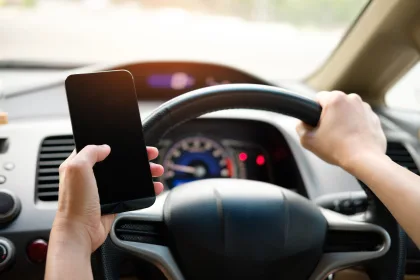
There are limited circumstances in which a device may lawfully be used. The clearest is when the vehicle is safely parked. That is not the same as being stationary in ordinary traffic. A driver stopped at traffic lights, queuing at a junction, waiting in congestion, or paused momentarily in the running lane remains engaged in driving for these purposes.
For a licensed taxi or private-hire driver, an allegation of unlawful device use is rarely confined to the fixed-penalty regime. It may also become evidence considered by a licensing authority when assessing whether the driver remains a fit and proper person to hold a licence. Where the conduct occurs while carrying passengers, while plying for hire, while undertaking booked work, or as part of repeated app-based driving behaviour, the licensing implications may become more serious.
Communication
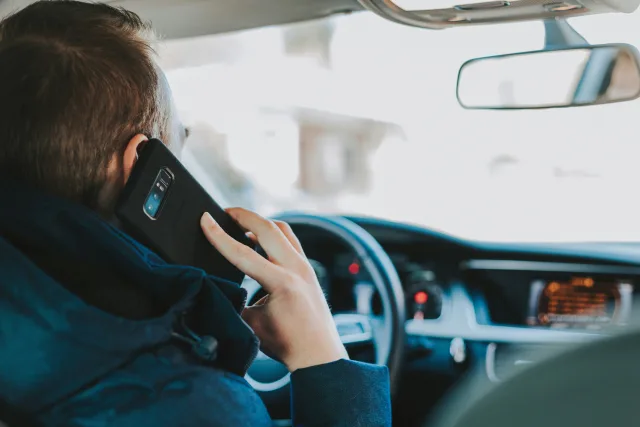
The 2022 amendment of the Regulation 110 of the Road Vehicles (Construction and Use) Regulations 1986 widened the offence so that it is no longer confined to interactive communication in the narrower pre-existing sense. It now refers to devices capable of transmitting and receiving data, even where that capability is switched off or temporarily unavailable. The amendment also widened the concept of “use”, including activities such as illuminating the screen, unlocking the device, checking the time, checking notifications, accessing an application, accessing the internet, taking photographs or video, and making or rejecting a call.
The Department for Transport’s public guidance expresses the position in more direct terms: it is illegal to hold and use a phone, sat nav, tablet or other device capable of sending and receiving data while driving. The guidance also confirms the standard fixed-penalty consequence of six penalty points and a £200 fine.
Section 3 of the Road Traffic Act 1988 creates the offence of careless and inconsiderate driving. Section 3ZA provides that a person is to be regarded as driving without due care and attention where the manner of driving falls below what would be expected of a competent and careful driver.
That is the legal framework within which app-based work must be judged.
For taxi and private-hire drivers, that means a driver must not pick up a phone to accept or reject a booking. They must not hold the device to read fare information, check a destination, review a passenger message, respond to an operator, or browse available work while the vehicle is being driven. The fact that the interaction is work-related does not remove it from the scope of the offence.
A booking app is not treated differently because it forms part of the driver’s means of earning a living.
Exceptions
Government guidance identifies limited exceptions, including use of a handheld device to call 999 or 112 in a genuine emergency where it is unsafe or impracticable to stop.
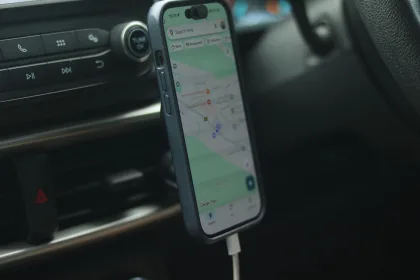
It also identifies circumstances involving safe parking, contactless payment in a stationary vehicle, and remote parking functions. Hands-free use may be lawful, but only where the device is not held during use. Examples include Bluetooth, voice command, dashboard holders, windscreen mounts, mats, and built-in sat-nav systems.
The practical difficulty for the licensed trade lies in the boundary between a handheld offence and the wider duty to drive safely. A driver may avoid the specific handheld mobile phone offence because the device is secured in a cradle and is not being held.
That does not mean the driving is necessarily lawful or professionally defensible.
A driver confronted with an allegation engaging the fit and proper test may need to address both the motoring law position and the licensing consequences.
A licensed driver depends not only on a DVLA driving entitlement, but also on the continuing confidence of the licensing authority. Road safety, compliance with legal obligations, honesty in reporting matters, and professional judgment are all relevant to the fit and proper assessment. A mobile phone offence may therefore become part of a wider regulatory evaluation.
A single fixed penalty will not always lead to suspension or revocation. Licensing decisions are fact-sensitive and must be proportionate. The authority will usually consider the nature of the conduct, whether passengers were being carried, whether there was poor driving, whether there was a collision or near miss, whether the driver has a previous motoring or licensing history, and whether the matter was promptly disclosed.
Consequences
And the Department for Transport’s Statutory Taxi and Private Hire Vehicle Standards state that, where an applicant has a conviction for using a handheld mobile telephone or handheld device while driving, a licence should not be granted until at least five years have elapsed since the conviction or completion of any sentence or driving ban, whichever is later.
That guidance is directed to applicants, but licensing authorities may also treat such offending as highly relevant when considering existing licence holders, renewals, reviews and enforcement action.
Repeated offences, concealment, minimisation, or evidence of routine app interaction while moving may all aggravate the position.
Non-disclosure often causes particular difficulty. Many licensing policies and licence conditions require drivers to notify the authority of convictions, fixed penalties, cautions, penalty points, arrests, charges or other relevant matters within a specified period. Where a driver fails to notify, the authority may treat the failure as a separate concern about honesty, openness and compliance.
In some cases, that failure may become more damaging than the original offence.
For newly qualified drivers, the practical consequence may be immediate. Six points within the first two years after passing the driving test can result in the revocation of the driving licence under the new driver regime. Without a DVLA entitlement, a taxi or private-hire driver cannot lawfully continue driving licensed vehicles.
Talal specialises in transport regulatory and licensing law, including representation before licensing sub-committees, Traffic Commissioners and appellate courts and tribunals. He represents drivers, operators and transport managers facing investigation, licence review, refusal, suspension, revocation or public inquiry arising from mobile phone use, app-based working practices or wider compliance concerns.

Contact Talal Malik at Transit Legal
Mobile: 07380 147535
Email: [email protected]
Web: transitlegal.co.uk